

12 Jul The Massacre of Saint Rémy
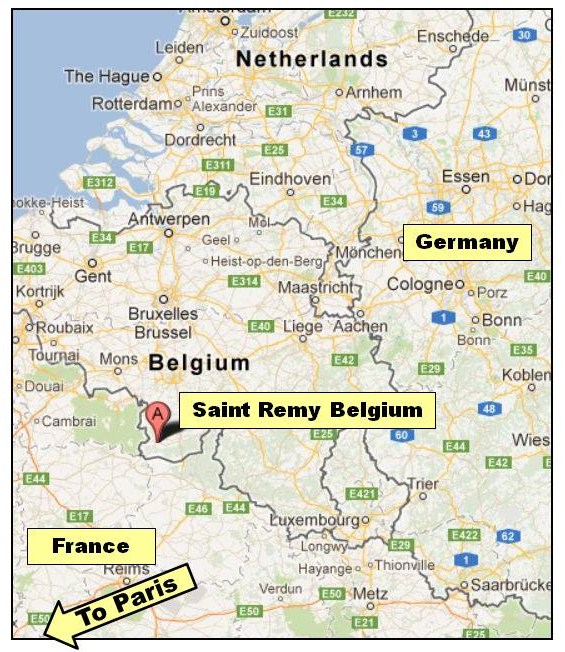
Map showing the site of the Massacre of Saint Rémy
After my Dad, B-17 bombardier Herman F. Allen, joined the 306th Bombardment Group at Thurleigh Airfield in November of 1943, two of his first missions (December 5 and 13, 1943) were with pilot Lt. Willard D. Reed. I was curious about Lt. Reed and began an internet search for more information. Lt. Reed’s B-17 was called the “Rationed Passion.”
The 11th of January 1944 was a rough day for the 306th. Herman was grounded with a burst eardrum but the rest of his regular crew flew with Charles W. Smith piloting a B-17 called “Weary Bones.” Their destination was a fighter aircraft factory at Halberstadt. Herman’s good friend Charles L. Stevenson, navigator, was killed on that mission. The rest of the crew returned unharmed.
On that same day, Lt. Reed and his crew flew the “Rationed Passion” for Halberstadt. Hit hard by flak the damaged plane went into a spin then, on fire, broke up in the air. The crew was reported as “Missing.” I have found conflicting accounts of what happened next. I am going to do the best I can and mention everyone with as much detail as I have been able to find. I hope that my readers will edit and/or confirm.
Those who died January 11, 1944, on the “Rationed Passion”
- 1st Lt. Thomas J. Brady, co-pilot (from Jamica, Queens County, NY, a former patrolman in the NY Police Department) bailed out but he died when he hit the ground either because his parachute malfunctioned or because he wasn’t able to open it.
- S/Sgt. Albert C. Schaeffler, left waist gunner died in the plane. (from Woodward, Woodward County, OK. Buried at the Netherlands American Cemetery in Margraten, The Netherlands.)
“Rationed Passion” crew members who were able to parachute out and safely landed in the Netherlands. Of course, all these areas in the Netherlands, France, Belgium were occupied by Nazi Germany.
- Lt. Willard D. Reed, pilot, from Tennessee, was captured by the Germans and became a POW at Stalag Luft 1. Lt. Reed died on October 30, 2000. Long a resident of Hot Springs, AR, his veteran grave marker, showing he was a Major, is in Dayton, TN.
- 1st Lt. Myron J. Dmochowski, bombardier, after landing near a small Dutch town became a POW. He was interned at Stalag Luft 1.
- 1st Lt. Ivan E. Glaze, navigator and S/Sgt. Warren W. Cole, tail gunner managed to evade capture. Members of the Dutch resistance helped the men get to the Franco-Belgium border, then finally to Paris where arrangements were made by the French underground to get them to England. They arrived there on the 28th of June.
- S/Sgt. Joseph G. O’Connell, ball turret gunner – captured and became a POW at Stalag Luft 4. He was from Watervliet, NY.
- T/Sgt. Orian G. Owens, top turret gunner/engineer, from Lisbon, Linn County, IA
- T/Sgt. Charles A. Nichols, radio operator, from San Joaquin County, CA.
- S/Sgt. John J. Gemborski, waist gunner, from Chicago, IL. Wounded, he at first managed to evade and was for a time with Ivan Glaze. He rests at the Netherlands American Cemetery in Margraten, the Netherlands.
The last three airmen, Sgts. Owens, Nichols, and Gemborski eventually made their way to Belgium where they were fed and housed by sympathetic farmers. They may also have been trying to get to Paris where they might have had a better chance of being returned to England.
Recently published is an excellent book by Steve Snyder, the son of the pilot of the Susan Ruth. Steve has documented these events in detail with letters and interviews that give us a better accounting of what these airmen went through. Shot Down: the true story of pilot Howard Snyder and the crew of the B-17 Susan Ruth.
Almost a month later, on February 8, 1944, the 306th BG went to Frankfurt, Germany. 1st Lt. Howard J. Snyder was the pilot of the B-17 “Susan Ruth.” After bombing, he was unable to get the bomb bay doors closed and fell out of formation. A German fighter knocked out engines 2 and 3. The oxygen tanks in the cockpit exploded, and the inside of the plane filled with flames.
Those who died February 8, 1944 on the “Susan Ruth.” Both men were killed instantly under Focke-Wulf fire on the way back from the target.
- T/Sgt. Ross L. Kahler, radio
- Sgt. Louis J. Colwart, Jr., ball turret
“Susan Ruth” crew members who were able to parachute out and landed somewhere in France.
- 1st Lt. Howard J. Snyder, pilot – Lt. Snyder was able to parachute out of the burning plane right before it fell apart. First farmers, then the Underground helped him evade the Germans. For a while Snyder fought with an active Maquis unit. He made it back to London by November. On August 27, 1989 he was in Belgium along with Slenker, Musial and Holbert the day a monument was inaugurated there.
- T/Sgt. Joseph J. Musial, waist gunner. When Musial landed he discovered that his left foot had been severed. When he landed in a field a French farmer helped him make a tourniquet and rushed him to a French hospital. The next day he was transferred to a Luftwaffe hospital in Brussels where he received excellent care. Musial was on his 2nd tour of duty. He had already flown more than 70 missions with the 13th AF in the South Pacific.
- 2nd Lt. Richard L. Daniels, bombardier, was wounded by exploding shells. He and Musial were treated together before becoming POWs.
- T/Sgt. Roy K. Holbert, engineer, became a POW at Stalag Luft 4 and was a part of the 86-Day March across Poland and Germany. He, Daniels and Musial were the only men from Snyder’s crew to go to prison camp. By the time Musial met up with Holbert he discovered that his jet black hair had turned snow white. Holbert died in Knoxville, TN on Jan. 30, 2010.
- S/Sgt. William O. Slenker, Jr. , tail gunner, was handicapped by a knee, foot, and leg wounds after the jump. He was courageously hidden by a Belgium family who nursed his wounds and cared for him for seven months until Liberation. They celebrated his 20th birthday there. Forty-five years later, in 1989, Slenker was reunited with this family. He died in Naples, FL on July 9, 2001.
- 2nd Lt. George W. Eike, copilot
- 2nd Lt. Robert J. Benninger, navigator
- Sgt. John K. Pindroch, waist gunner
Airmen Eike, Benninger and Pindroch all evaded capture once they were on the ground and were helped by the French underground.
The Massacre of Saint Rémy
On April 22, 1944 eight American airmen were having breakfast together in a shelter in Saint Rémy, a small heavily wooded Belgian village near the larger town of Chimay. The Americans were:
- T/Sgt. Orian G. Owens, engineer – from “Rationed Passion”
- T/Sgt. Charles A. Nichols, radio – from “Rationed Passion”
- S/Sgt. John J. Gembrowski, waist gunner – from “Rationed Passion”
- 2nd Lt. George W. Eike, copilot – from “Susan Ruth”
- 2nd Lt. Robert J. Benninger, navigator – from “Susan Ruth”
- Sgt. John K. Pindroch, waist gunner – from “Susan Ruth”
- Sgt. Vincent J. Reese, waist gunner, from Philadelphia. On December 30, 1943, the B-17 “Women’s Home Companion” from the 303rd BG crash landed at Cerfontaine, Belgium, in a field near the Luxembourg-French-Belgian border. After evading capture Sgt. Reece joined and fought with the underground.
- 2nd Lt. William H. Huish, navigator of the 91st BG’s B-17 “Skunkface” which had crashed on February 20, 1944. (The pilot of his plane was 1st Lt. Ernest B. Kidd. He along with most of the crew became POW’s.)
As they were finished breakfast, the men heard the sound of automatic weapons being fired. They, along with farmers who had helped them, were taken prisoner by men in German uniforms. They had been betrayed. At the same time thirty Belgian citizens from Chimay were also arrested and sent to concentration camps.
The airmen were undressed and searched. Because of their dogtags they could never have been thought to be Freedom Fighters.
That afternoon the Americans, hands tied behind their backs, were taken into the woods near where they had been captured. Each was accompanied by two armed men in German uniform. The eight men were separated, and on a signal each was shot several times in the back by gunfire. Their bodies were put into a mass grave at the military airfield near Gosselie. Later their remains were transferred to the military cemetery at Margraten, the Netherlands where they were buried with honors.
After the war was over Belgian military authorities prosecuted a few of those who committed this heinous crime. They were either sentenced to death or served time in jail.
It took nineteen long months before the families of the eight airmen learned what had happened.
This has been a long post. I want to pay tribute to these airmen as well as the brave resistance fighters who helped them in their efforts to evade capture by the Germans. It is one more example of how much terror these young men had to endure above and beyond the murderous flak and enemy fighters. In a matter of seconds they could be forced to parachute from a plane on fire and ready to explode, only to land in enemy country, then once there struggle to hide from Germans and crazed traitors.
It’s a miracle that I’m even here. We can never thank our veterans enough.
My main sources of information:
- Downed Allied Airmen and Evasion of Capture: the Role of Local Resistance Networks in World War II by Herman Bodson. 2005
- First Over Germany: A History of the 306th Bombardment Group by Russell A. Strong. 1982.
- Shot Down: the true story of pilot Howard Snyder and the crew of the B-17 Susan Ruth by Steve Snyder, 2014 (published after I wrote this account.)
Important Update: I have now received additional information from the son of Lt. Snyder, pilot of the “Susan Ruth.” He shared with me a letter written in 1947 by the father of Lt. George W. Eike, one of the boys who was murdered that day. Mr. and Mrs. Eike, with help from their Senator and others, were able to push for a complete investigation of the incident. They went to Washington, D.C. to read it and wrote to each boy’s next of kin to relate basically what I described above. I use the word “boy” because that is the word they used. The Eike family had two sons, and both died in the war. Their other son Richard was the pilot of a B-17 that was shot down and exploded in September 1944.
We pray that they did not die in vain and that generations to come will never forget their great sacrifice. (Derwood W. Eike, father of George and Richard)
Lt. Snyder’s son Steve explained that family members have attended celebrations of the Belgium Liberation and some will be going back in 2014 for the 70th. There is a monument to the “Susan Ruth” and crew in Macquenoise as well as a museum with many pictures and artifacts from the war. A local organization called the Belgium/American Foundation puts on parades, speeches, and parties every year which are wonderful, moving events. Even American military dignitaries headquartered in Brussels attend. All to keep their memories alive.
I have written more about Howard J. Snyder and the “Susan Ruth” here.
Update: March 2013 – Thank you to Edouard Renière from Brussels for adding some of the details above. Family and relatives of the crew will be going to Belgium in May, 2014 to celebrate the 70th Anniversary of the Susan Ruth being shot down at Macquenoise and to celebrate the Belgium Liberation. Edouard will meet with them at that time.
Barbara Ann Davis
Posted at 06:27h, 13 JulyPowerful….thanks!
Dave
Posted at 10:31h, 28 JulyThank you for including T/Sgt Orian Owen’s information in your excellent post. I “discovered” him last year in a short write up on Lisbon High School alumni. I researched his WWII story and eventually found his gravesite in Lisbon, Iowa. Then posted a story about him on my blog (42n.blogspot.com)last November. Since then I have researched a few more details about Orian and have made sure that a small US flag flys over his grave. Through the work of the Lisbon Historical Society (Lisbon, Iowa,) my blog, your book project and other researchers that the sacrifices made by Orian and other crew members will continue to be remembered and shared.
Bob Norman
Posted at 14:34h, 02 FebruaryAll these great stories about the boys. and the people that helped them on the ground.
George Eike was a great guy and would have had a great life but his Dad said it all.
George was my cousin and when the time comes I’ll get more facts from him.
Pat DiGeorge
Posted at 19:36h, 02 FebruaryGeorge, thank you so much for your comment. And when the time comes please look for me. I’ll want to know too …
Pat DiGeorge
Posted at 19:43h, 02 FebruaryDave, thank you for your recognition for Orian Owens. You’re right … it’s important that the story be shared.
Keith Houin
Posted at 17:08h, 03 AprilCould you please contact me. I am running a official DoD website and podcast about the liberation of the Benelux and would like to chat about the Susan Ruth. It is one of the annual memorial events my office and unit participate.
Pat DiGeorge
Posted at 08:23h, 04 AprilKevin, I tried to contact you. I can put you in touch with the son of the pilot of the Susan Ruth. Your email doesn’t work for me. THANKS, Pat
Clarence Miller
Posted at 18:14h, 16 MayThanks for the research you did into the Saint Remy Massacre. Orian Owens was my cousin. I was only about one year old when his B-17 went down in the Netherlands according to the crew member reports posted on Fold3. No one ever mentioned what happened to him. As I began working on our family history his life was very intriguing to me.
It makes me very proud and thankful that these young men in the prime of their lives made the ultimate sacrifice for our freedom.
Again, thank you so much for this article. I will include it in his family profile.
Pat DiGeorge
Posted at 15:40h, 19 MayClarence, did you read all the comments at the bottom of the post? Your cousin was mentioned! Plus, a gentleman I met through the 306th Bomb Group reunions (our Dad’s bomber group) has written a book, not quite yet published, about the events. SteveSnyderAuthor.com is his website. If you are on Facebook, we are part of an active Facebook Group, 306th Bomb Group – First Over Germany. Please join us!
Jan Nieuwenhuis
Posted at 15:01h, 08 JuneHave just added the details of the crash of B-17 42-30782 “Rationed Passion” into my database “World War II Allied Aircraft Crashes in the Netherlands and North Sea” at https://www.airwar4045.nl
Currently the database holds the data on 5 more 306BG crashes… 42-29971, 42-31236 “Arch Bishop”, 42-31538 “Norah”, 42-5072 and 42-5180.
Any comments and/or information is most welcome…
Pat DiGeorge
Posted at 06:00h, 09 JuneThank you! I have added this information to our Facebook group: 306th Bomb Group – First Over Germany.